


Fraud detection is no longer just a technical challenge, it’s a strategic and executive imperative. While many industries, especially financial institutions, are at varying levels of fraud detection maturity, leaders across the board e.g. COOs, CROs, CTOs, CISOs, and Data Platform Owners—share the responsibility of shaping systems that can detect, respond to, and adapt to fraud in real-time.
This series explores the evolving fraud landscape; from types and root causes to real-world impacts and modern solutions. Whether you’re a business decision-maker or a technology leader, this series will guide you toward building a smarter, more autonomous fraud detection framework—one that keeps pace with ever-evolving threats.

Part 1: Disrupting the Disruptors – Why Fraud Detection Needs a Rethink
Introduction – Why This Matters
Even recent incidents (Fixed Deposits fraud in a Bank) have shown how internal fraud, enabled by access misuse and insufficient control, can quietly siphon off large sums over years without detection. These events and many more underscores the urgent need for financial institutions to rethink fraud detection as a multidimensional, fast-evolving threat.
Today’s fraudsters don’t rely on brute force—they move with speed, coordination, and precision, leveraging bots, synthetic identities, and even AI. If our systems only respond to their actions, we’ll remain in perpetual catch-up mode.
What’s needed is a shift in mindset—from reactive defenses to proactive intelligence. We need platforms that can sense, reason, and act ahead of the fraudster. Not just detecting anomalies, but anticipating and interrupting fraud before it happens.
Established solutions like FICO Falcon Fraud Manager and NICE Actimize have served as strong fraud detection platforms for years. However, today’s threat landscape demands these tools be integrated or extended with enterprise-level solutions that can close strategic gaps. In this series, we’ll explore how to rethink fraud detection using agentic AI, ML, and modern data engineering practices. We’ll categorize fraud patterns, map them to smart detection strategies, and show how to stitch together a real-time, adaptive fraud detection platform that evolves as fast as the threat landscape. As fraudsters evolve with bots, synthetic identities, and AI-driven attacks, legacy defenses, often static and siloed, can no longer keep up.
The Rising Tide of Financial Fraud
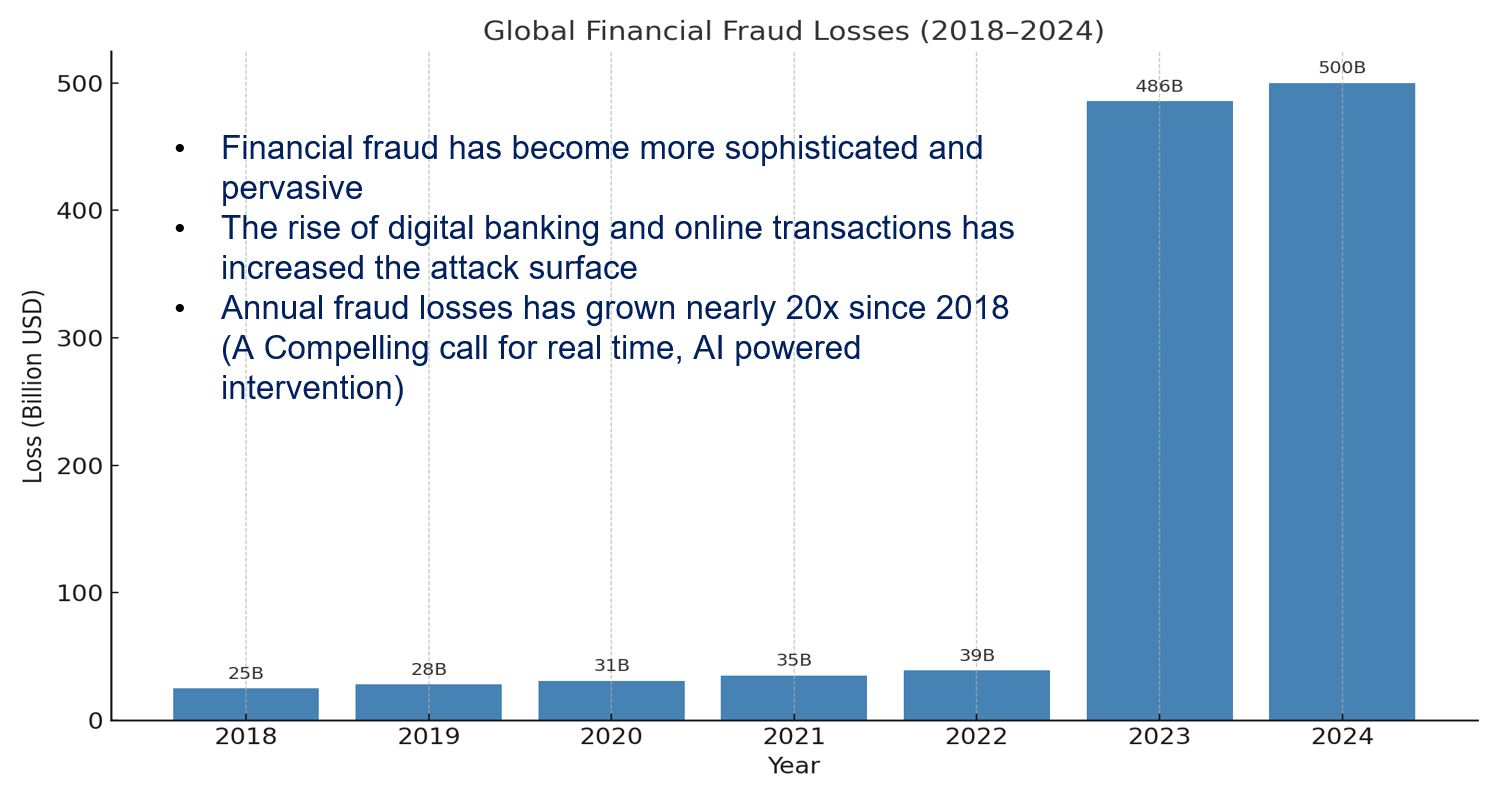
In 2018, global fraud losses stood at $25 billion. Today, that number has skyrocketed past $500 billion—a staggering 20x jump driven by the rapid adoption of digital banking, real-time payments, and AI-enabled attack vectors. The fraud landscape has become more dynamic, more sophisticated, and far more destructive.
Recent estimates for 2023 show that over $485 billion in global financial losses were driven by just five dominant fraud types—ranging from ATO (Account take over), credit card fraud to wire transfer fraud. These figures reinforce the urgency for modern, proactive defenses that can tackle both scale and complexity.
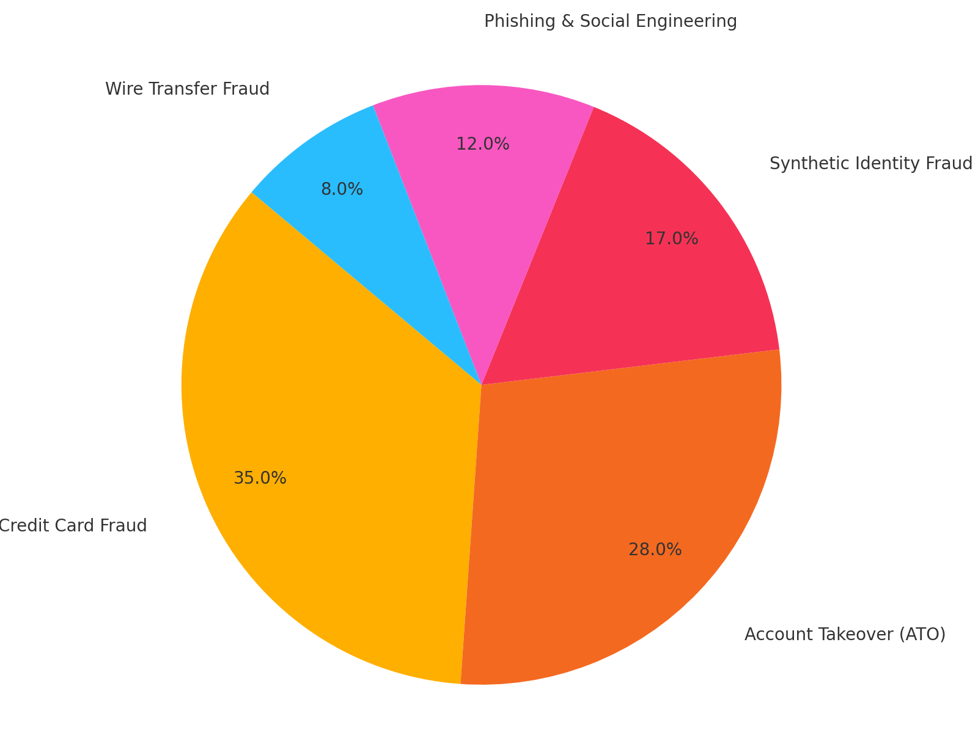
Financial institutions today are up against a fast-evolving adversary, fraudsters who continuously adapt and outpace static, rule-based detection systems. Armed with bots, synthetic identities, social engineering tactics, and access to leaked data, they exploit gaps with increasing precision. As a result, the fraud threat landscape is not only growing in size but also in complexity and unpredictability.
Why Yesterday’s Defenses Won’t Work Tomorrow
Traditional fraud systems, built on siloed rules engines, batch validations, and human case reviews are no match for real-time attacks. These systems:
- Operate reactively instead of proactively (e.g. detect fraudulent withdrawal post it occurs)
- Struggle with cross-channel detection (e.g. connect phishing emails to subsequent login anomalies followed by fund transfer across different systems)
- Lack semantic understanding or real-time signal correlation (e.g. making hard to interpret atypical sequences e.g. password reset + new device login+ fund transfer)
- Can’t scale to handle new fraud typologies like deepfake-based identity fraud (e.g. traditional KYC process can easily be tricked)
This fragmentation and lag create windows of opportunity that fraudsters exploit with surgical precision.
Introducing the Four Core Fraud Categories
To build smarter, more adaptable fraud detection systems, we need to categorize fraud not by static use cases, but by behavioral and structural characteristics. We propose four high-level categories:
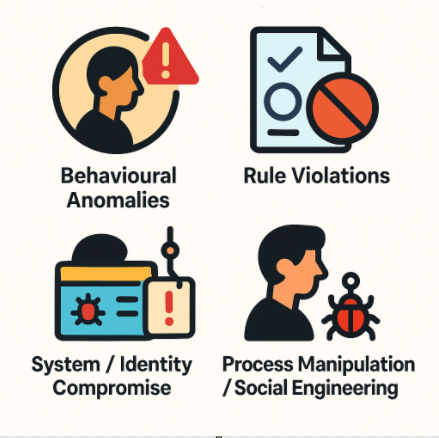
- Behavioral Anomalies – Unusual user or system behavior (e.g., sudden location or transaction shifts)
- Rule Violations – Clear breaches of policy thresholds or red flags (e.g., structuring, sanctioned entities)
- Process Manipulation / Social Engineering – Fraud via interaction abuse, phishing, or fake tickets
- System / Identity Compromise – Credential theft, device spoofing, API exploits
Each category calls for a different blend of detection strategy, ranging from real-time ML to context-aware agents.
Proposing a Unified, AI-Native Platform: Unified Fraud Detection Platform (UFDP)
We must shift toward an AI-native, real-time, and integrated fraud detection platform that combines the following: –
- Agentic AI: Goal-driven agents that collaborate and act autonomously
- ML & Anomaly Detection: Adaptive learning from user and transaction behavior
- GenAI (LLM to LMM) Models: Understand context, generate rules and explain incidents
- Distributed System Engineering: Orchestrator involving distributed storage, in-memory, message Q, LB, RTOS (Real-time) etc. to support Agentic AI framework
- Data Engineering Pipelines: Stream and batch layers working in unison
- MLOps, DataOps, LLMOps : Lifecycle management of models, data, and agents
UFDP: A framework that transforms isolated systems into a living, evolving intelligence fabric.
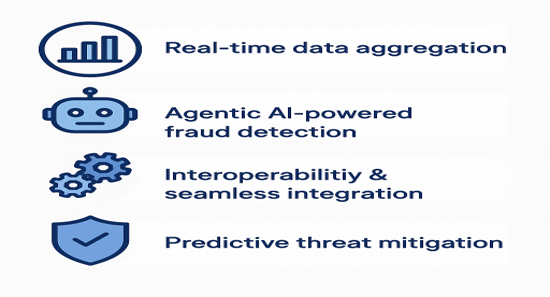
Vision: Build a unified, AI-native platform that proactively detects and prevents complex financial fraud by integrating ML, LLMs, and GenAI delivering real-time protection without compromising customer trust. A Unified Fraud Detection Platform (UFDP) is designed to break down silos by offering Real-time data aggregation, agentic AI-powered fraud detection, interoperability & seamless integration, predictive threat mitigation.
In Part 2 of this series, we’ll dive into the architectural foundation of the UFDP, explore the sandbox-operational tier model, and map technologies to fraud categories.
Stay tuned. We’re just getting started !!!
