

As global digital payment streams scale, enterprise fraud detection systems face a continuous trade-off between execution latency, deep analytical reasoning, and the critical need to minimize both false negatives (FN) and false positives (FP). While frontier reasoning models offer unprecedented analytical depth, routing every incoming transaction payload through them creates severe performance bottlenecks and unsustainable compute overhead.
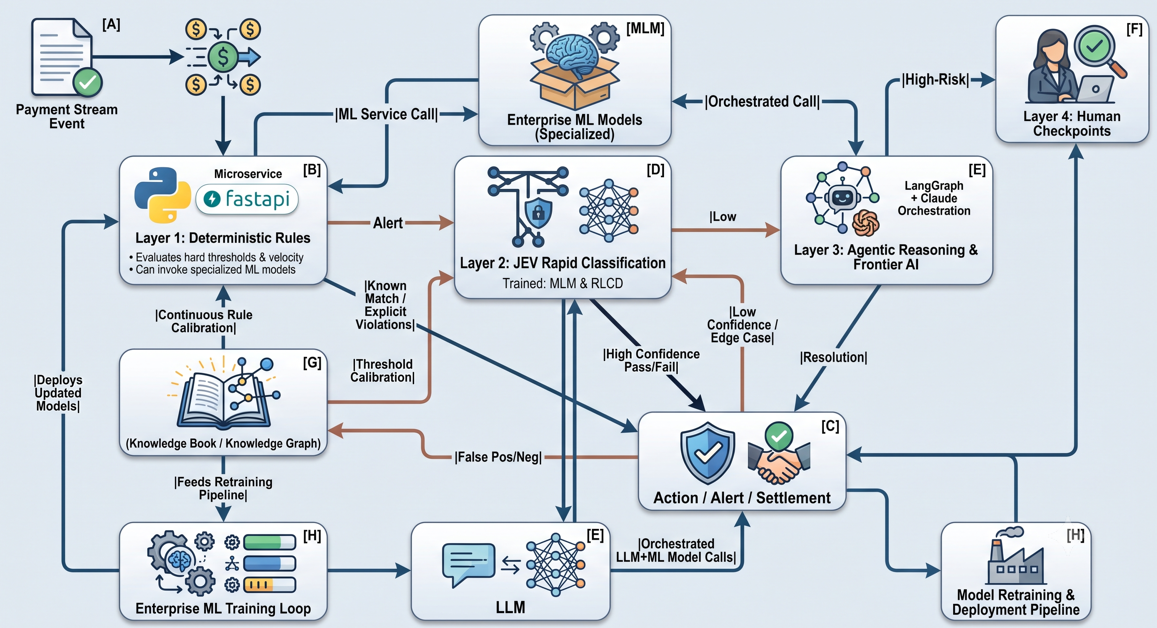
To address this challenge, we propose exploring a tiered, hybrid architecture for the Unified Fraud Detection Platform (UFDP) v3.0. This framework pairs deterministic rule filtering with JEV, a specialized, high-speed decision engine, before selectively escalating complex edge cases to full agentic workflows.
Because fraudulent patterns are inherently novel and dynamic, this proposal aims to analyze and quantify the incremental performance gains JEV can deliver. We will explore how effectively JEV can operate as a fast primary classifier, while determining where auxiliary systems remain necessary to derive comprehensive risk scores across the entire fraud detection ecosystem.
1. Deterministic Rule Filtering (Layer 1)
The pipeline begins at the ingest layer, where incoming payload streams pass through deterministic rules implemented via lightweight microservices (such as Python/FastAPI). These rules evaluate explicit, non-probabilistic conditions and can directly invoke specialized, lightweight ML models (e.g., isolation forests for anomaly detection) for instant scoring.
Concrete Examples:
- Geo-Velocity Anomaly: A transaction originates from an IP address in London just 10 minutes after a physical credit card swipe in Bengaluru.
- Odd-Hour High-Value Swipes: A transfer exceeding $10,000 initiated at 3:00 AM local time from a country outside the user’s registered home region.
- Rapid-Fire Card Testing: More than 5 failed PIN/CVV validation attempts within a 30-second window.
2. High-Speed Classification via JEV (Layer 2)
Uncertain payloads immediately transition to JEV. Built upon a specialized architecture trained via Masked Language Modeling (MLM) and refined through Reinforcement Learning with Calibrated Decisioning (RLCD), JEV delivers rapid probabilistic classification in milliseconds. JEV can also consume feature scores generated by upstream or co-located traditional ML models.
Crucially, JEV is architecturally constrained to stay strictly within its input text/payload. It does not perform function or tool calling, nor can it query external state databases or third-party APIs. This deliberate isolation ensures near-instantaneous execution times and predictable compute costs.
Concrete Examples:
- Payload Text Pattern Matching: Classifying free-text remittance notes or transaction descriptions containing disguised phishing keywords or scam syntax (e.g., “urgent family emergency gift transfer”).
- Structured Payload Risk Scoring: Evaluating structured JSON metadata (device fingerprint strings, user-agent headers, and merchant categories) to return a probability score (e.g., Fraud Risk: 0.82, Confidence: High).
3. Agentic Reasoning & Frontier Models (Layer 3)
When a payload’s context is too ambiguous for JEV to classify with high confidence, the system escalates the transaction to an agentic framework (built on LangGraph and powered by frontier models like Claude/GPTxx). At this layer, the agent actively orchestrates tool calls across disparate enterprise systems and coordinates specialized deep ML models (such as graph neural networks for fraud ring detection).
Concrete Examples:
- Multi-System Cross-Referencing: An agent queries customer support interaction logs in the CRM to verify if the user recently reported a lost device, while simultaneously checking core banking APIs to evaluate 90-day balance trends.
- Behavioral Sentiment & Social Context: Analyzing recent customer emails or chat transcripts indicating potential account takeover or voice-phishing coercion (“grandparent scam”) before approving a wire transfer.
- Cross-Merchant Graph Analysis: Identifying if an unknown merchant account is part of a newly formed synthetic identity fraud ring across multiple partner institutions.
4. Human Checkpoints & Knowledge Book Integration (Layer 4)
For transactions exceeding critical financial thresholds or cases where the agentic layer yields high uncertainty, the workflow routes the payload directly to an operational review dashboard for human analyst validation.
Concrete Examples & Feedback Loops:
- High-Value Wire Escalation: A $250,000 corporate transfer flagged for subtle behavioral changes requires explicit human sign-off via an operations dashboard.
- Knowledge Book & ML Retraining Loop: Every verified outcome—specifically flagged false positives (legitimate transactions flagged as fraud) and false negatives (missed fraud)—is ingested into an enterprise Knowledge Book (Knowledge Graph).
- Continuous Calibration: This accumulated intelligence continuously adjusts Layer 1 deterministic rules, recalibrates JEV’s confidence thresholds, and feeds directly into the enterprise ML Training Pipeline to retrain underlying classifiers across all layers.

Leave a Reply
You must be logged in to post a comment.